Sunday, March 6, 2011

Theatre History II Entry 3


I found these videos of “A Midsummer Night’s Dream” during my research. For ten minutes and kid friendly I think they are pretty accurate. I love how they mix modern English with old age English. The idea is cute, and is a fun way to introduce the show to kids.
The Disney version above focuses on the lovers. It is acurate for being so short and kid friendly. They did not introduce the fairies or band of actors. One thing that confused me was they used the Disney character's names for most of the characters, but Puck and Oberon were Puck and Oberon. Over all I enjoyed watching it and it was a fun break from the books.
"Midsummer Night's Dream - Part 1 (1999)." YouTube. Web. 6 Mar 2011. http://www.youtube.com/watch?v=WMIAGXDyN-s.
"Midsummer Night's Dream - Part 2 (1999)." YouTube. Web. 6 Mar 2011. <http://www.youtube.com/watch?v=1GQ61ydpYnw&feature=related>.

Theatre History II Entry 2

The primary document Elizabethan Acting: An Excellent Actor by Alfred Harbage states that the actor charms our attention. He is in deep thought and the audience is captivated. Harbage believes that acting is a formal performance. Which is something that many people do not associate with Elizabethan times. Harbage says “ Hee is so much affected to painting, and tis a question whether that make him an excellent Plaier, or his playing an exquisite painter.” I read this as Harbage saying that the actor is so committed to his “painting” that the audience is not sure if they are watching a painter paint, or if they are watching an actor act like he is painting. Showing that the actors had great commitment to their work in the Elizabethan theatre.

"Sir Lawrence Olivier as Hamlet." Famous Shakespearean Actors. Web. 6 Mar 2011. http://www.factmonster.com/spot/shakespeareactors.html.

Harbage, Alfred . "Elizabethan Acting ." A Source Book In Theatrical History. Comp. A.M. Nagler. New York: Dover Publications, 1952. Print.

Theatre History II Blog Entry One

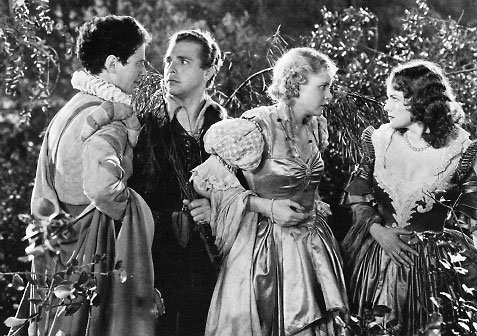
I chose to research A Midsummer Night's Dream by William Shakespeare for the blog assignment. A Midsummer Night's Dream is a comedy about four "lovers" who have an eventful night in the forest.

Theseus, duke of Athens, is preparing to marry Hippolyta, queen of Amazons. He is searching for "proper" entertainment for the wedding festival. Egeus, an Athenian nobleman, is the father of Hermia and he wishes her to wed Demetrius. Hermia wishes to marry Lysander. Hermia and Lysander make plans to escape Athens and marry. They tell Helena, Hermia's friend, of their plans. Helena was once engaged to Demetrius and loves him still. Helena sees this as her chance to get Demetrius back and tells him of the couples’ intentions.  Demetius marches into the woods with Helena following.

In the woods are a band of fairies and a band of Athenian craftsmen rehearsing a play that they hope to perform for the Duke's wedding. Oberon and Titania, the fairie king and queen, are arguing over an Indian prince given to Titania as a gift. In an act of revenge Oberon send his servant, Puck, to find a magical flower. The juice of the flower, when spread over a sleeping person's eyes, causes the person to fall in love with the first thing they see upon waking. Puck is to spread it over Titania's eyelids, but after seeing Demetrius be cruel towards Helena he orders Puck to spread the juice on the eyelids of a young Athenian man. Puck finds Hermia and Lysander in the woods. Thinking this is the man he gives Lysander the love potion. Upon waking Lysander happens to see Helena first. He falls deeply in love with Helena. The rest of the evening Puck tries to fix his mistake. In the process Demetrius is put under the spell of the love potion and falls in love with Helena as well. Helena thinks that the men are mocking her. 

Hermia challenges Helena to a fight out of jealousy. Lysander and Demetrius almost fight over Helena's love. Puck imitates their voices to confuse them. He leads them away from each other until they are lost in the woods. Puck spreads the love potion on Lysander’s eyelids, and by morning all is well. Theseus and Hippolyta discover the sleeping lovers in the forest and take them back to Athens to be married—Demetrius now loves Helena, and Lysander now loves Hermia. The acting troop performs for the group wedding and the show ends with Puck asking for forgiveness if the show offended anyone.

SparkNotes Editors. “SparkNote on A Midsummer Night’s Dream.” SparkNotes.com. SparkNotes LLC. 2002. Web. 24 Feb. 2011.

"Lord, what fools these mortals be!." A Midsummer Nights Dream. Web. 6 Mar 2011. <http://collegiatelabs.com/midsummernight/?page_id=9>.

Tuesday, December 7, 2010

Medieval Blog Entry Ten


This is another way productions were set up in Medieval times

For my primary document I chose English Pageant Cars by Archdeacon Robert Rogers. He left a description of the pageant cars used in the Chester Whitsun plays.
Rogers describes them in old English. He describes them as having 2 “rowmes”. One higher and one lower, they were placed on four wheels. The lower one was used as a backstage to “apparel” themselves. The higher one was used to perform. It was raised so all could see and hear them. Rogers says “The places where they played them was in every streete.” So the cars were wheeled from place to place to perform in different locations around town.

This is one interpretation of a pageant car

According to Nagler in his book The Medieval Religious Stage the main source that we have to support the procession theory for the Chester Cycle is in David Rogers’ description. However, he wrote his history 34 years after the last performance in Chester, since we do not know how old he was when he wrote his history we cannot assume that he was an eyewitness as previously thought. His father is the same Robert Rogers mentioned above; so some believe that David got his information from his father, who would have been an eyewitness. Rogers listed five points within the city for performances: at the Abbey Gate, at the High Cross, in Watergate Street, Bridgegate Street, and Eastgate Street. Rogers also stated that the wagons followed each other smoothly without interruptions. (Nagler)

Nagler, A.M. The Medieval Religious Stage. New York, NY: Yale University, 1976. 55-56. Print.
Rogers, Robert . "English Pageant Cars ." A Source Book in Theatrical History. Comp. A.M. Nagler. New York: Dover
          
Publications, 1952. Print.
"Stage Design in the Middle Ages ." THR 100: Drama Appreciation. Web. 7 Dec 2010. http://www.uncg.edu/aas/itc/thr100/unit14/part2.html


Medieval Blog Entry Nine

Lin, Erika T. "Popular Festivity and the Early Modern Stage The Case of George a Greene." Theatre Jounal Volume 61.2 (2009): 271-97. Web. 7 Dec. 2010.

The following scholarly article discusses the Cycle plays and their commonality (or lack of) in English theatre.

Popular Festivity and the Early Modern Stage The Case of George a Greene
Erika T. Lin
Theatre Journal, Volume 61, Number 2, May 2009, pp. 271-297 (Article)
Published by The Johns Hopkins University Press

"Recent work associated with the Records of Early English Drama (REED) project, however, has demonstrated the persistence of popular festive performance. Although the demise of the biblical cycle drama certainly took place, it has become increasingly evident that these plays were, in fact, never as widespread as has been generally assumed and were enacted only in urban centers such as Chester and York. Far more common across the whole of England were various kinds of theatrical and paratheatrical activity at the parish level." (Lin 271- 272)

This was new information to me. I did not realize that more study had been done, and that scholars were finding that the cycle plays were actually not as common as people originally believed.

Lin goes on to say that the parish festivals were generally unscripted. While cycle plays have more textual traces. Because of this the cycle plays are more studied and there is more known about them. The Festivals were given much less critical study than the Cycle plays.
  
"Yet if regular participation in amateur performance was commonplace in early modern England, its impact on the growth of professional theatre must have been significant." (Lin 272) How did the other festivals impact the growth of theatre in England? Lin states examples where later plays had festivals in them. Such as The Winter's Tale where there is a sheep shearing festival.

I thought that Lin brought up a subject that could be a whole blog in itself.  

Medieval Blog Entry Eight

The passage of the Bible that the second Chester Cycle play is written from is Genesis 1-3. The opening speech by God follows almost exactly the same order presented in the Bible. The serpent's speech in the play is similar to that of the Bible. Both convince the women that she will become more God-like if she eats the fruit.

In the Bible it says "She took some and ate it. She also gave some to her husband, who was with her, and he ate it." (Genesis 3:6) This goes back to the discussion about Eve being the first sinner. If Adam was there with her why did he not stop her? After sinning they both realized that they were naked and then they made clothes out of fig leaves.

In the play it calls the fruit an "apple" in the Bible there is no mention to what kind of fruit is on the tree. For all we know it could be a fruit that no longer exists.

At the end of the play God puts cherubim and flaming swords at the entrance of the garden. This is Genesis 3:24, which is the end of the chapter.


Chester Cycle 1572/2010 A.F.Johnston, ed. (from Mills) Play 2
Chester Cycle 1572/2010
Play 2
Adam and Eve

Holy Bible. Grand Rapids: Zondervan, 2002. Print.

Monday, December 6, 2010

Medieval Blog Entry Seven

In the book Eve by John A. Phillips while talking about Eve as the "original sinner" Phillips states that the women dominates the story of the Garden of Eden. It is true. She is the one who talks to the serpent (Devil) and the one who takes the first bite. Then she "assumes the role of the serpent... in providing her husband with the fruit." (Phillips 55) Many people blame the woman for bringing sin into the world, but in Phillips book he argues that Adam fell with even less persuasion than Eve. If the serpent had talked to Adam first, would he have eaten the fruit faster than Eve?

There is no way that we could ever truely know the answer to that question. We cannot go back in time to see what Adam would do. People have discussed whether sin is Eve's "fault" or not for centuries. I was raised in the Christian church and I have heard many sermons, speeches, and discussions on the story of the Garden of Eden. As far as I can see we are no closer to having an answer now than they were 50 years ago. Phillips has some good points in his book Eve, and I would reccomend it to someone looking for someone's point of view on it.

Photograph. Christ Church of Peach. Web. 6 Dec. 2010. http://christchurchofpeacejacksonville.org/services.
 
Phillips, John A. Eve: The History of an Idea. 1st ed. New York: Library of Congress, 1984. Print.